← jwawong

Case study · 2025–2026

Allmap.io

A collaborative mapping platform where creators build private maps and earn money from them. Designed, built and shipped by one engineer.

Joshua Wong — solo founder-engineer · product, backend, frontend, mobile, infra

  • 1.1M+trails rendered worldwide
  • 559commits in one year, solo
  • 3platforms: web, Android, iOS

The map behind this page is live. Scroll to move it.

01 · The problem

Maps are where people plan their lives, but creators can't own one.

Travel creators, guides and local experts pour knowledge into Google lists and spreadsheets that they can't brand, gate or charge for. Allmap gives them a map of their own: private or public, collaborative, with paid access built in.

How it works · Layers

See all your reasons to go outside in one place.

Every map is a layer: restaurants, climbing crags, pickleball courts, hot springs. Stack the ones you like and hide the rest. Click a pin on the map.

How it works · Pins

A pin marks a place.

A restaurant, a viewpoint, a friend's house. Each pin carries photos, an address, tags and links, and opens with directions one tap away.

How it works · Events

An event is a pin with a date.

Concerts, markets, meetups. Ticketmaster events stream in automatically, refreshed every day across 249 city cells.

How it works · Routes

A route is a path on the map.

Draw it point by point, upload a GPX file or record it live. Distance, elevation and the profile are worked out for you. The amber lines are 1.1M real trails.

How it works · Messages

Leave a note on the map.

A tip, a label, a comment for whoever comes by. Messages sit on the map as speech bubbles.

How it works · Paint

Color the map by what it's like.

Turn Paint on and color the shared map by category. Every cell painted earns karma.

    How it works · Map details

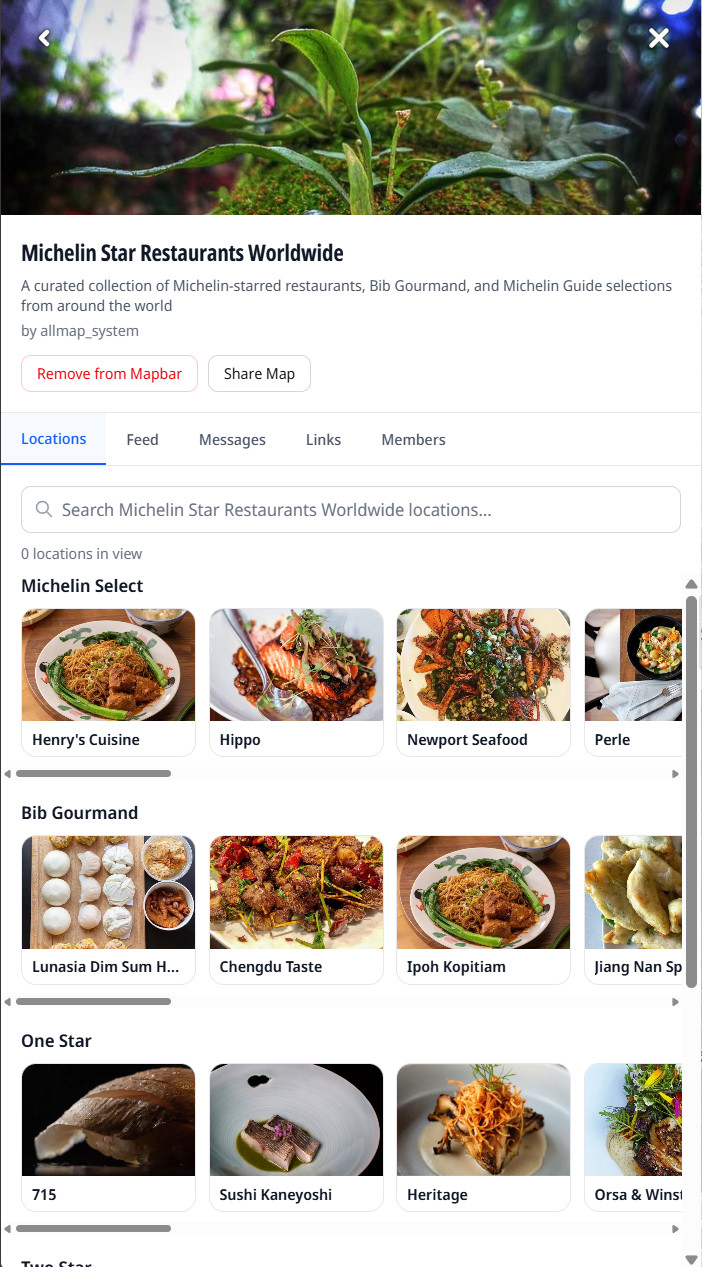
    Every map is a place to browse.

    Open any map to see its locations, feed, messages, links and members. Click an item to fly straight to it.

    A map's detail view: cover photo, description, and tabs for Locations, Feed, Messages, Links and Members.

    02 · What I built

    A full product, not a prototype.

    Django 5 + DRFPostgreSQL + PostGISNext.js 16MapLibre GLCapacitor 8Stripe ConnectCloudflare R2Render

    03 · Architecture

    New map features plug in. Nothing else changes.

    Every map is a stack of layers: pins, routes, drawings, paint grids, text. Each layer type is one self-contained handler that owns its own data format, validation and updates. The API finds handlers on its own, so adding a layer type means writing one backend class and one frontend component.

    Mappermissions LayerJSON config BaseLayer render_data()validate_data()process_update() location · routedrawing · pixel_gridtext_grid · + yours REST API v2auto-discovers handlers MapLibre componentone per layer type

    Why it matters: five layer types shipped without touching the core. The registry stays thin and each handler stays deep.

    04 · Scale & performance

    Designed for millions of places on a phone.

    1.1M trails without melting the browser

    Problem: streaming route GeoJSON from the API stalled at scale.

    Decision: pre-render routes into PMTiles vector tiles with a parallel tippecanoe pipeline (6× faster), hosted on Cloudflare R2.

    Result: a 2.1 GB tileset served as byte-range requests from a CDN, with no API server in the path. That's what you're seeing on this map.

    150 queries → 11

    Problem: the map list fired an N+1 query storm.

    Decision: prefetching, dynamic field selection and slim marker types at ingestion.

    Result: 93% fewer queries per load. Clustering moved to a web worker, and the cache uses LRU eviction.

    Fresh events on a fixed API budget

    Problem: Ticketmaster caps calls per day and per second.

    Decision: 10 staggered cron jobs across 249 city cells in tiers, ordered so polling always reads fresh counts.

    Result: about 4,500 calls a day, always under 5 req/s, with a 500/day on-demand safety valve.
    • —locations
    • —events
    • —maps
    • —users

    05 · AI-first engineering

    One engineer, the output of a small team.

    I build with AI coding agents as the primary implementers and act as architect and reviewer. Speed alone doesn't make that work. Discipline does, so I wrote it down:

    • A written engineering constitution (CLAUDE.md): deep modules, information hiding, errors defined out of existence. Agents follow it on every change.
    • Guardrails over trust: CI on every push (pytest, Playwright, Black, Flake8, Trivy, Bandit) before auto-deploy.
    • Plan → implement → review loops for anything that touches more than 3 files or the schema.
    • Canonical patterns named in the docs (for example the anti-drift marker structure), so agents copy the right thing.
    Commits per week, by area

    06 · Results & next

    Live, monetizable and still shipping.

    • Live at allmap.io on web, Android and iOS.
    • Creator economy end to end: subscriptions, one-time purchases, Stripe Connect payouts and contributor revenue sharing.
    • Search relevance ranking, onboarding and guided tours, PostHog analytics.

    What I learned

    AI agents make writing code cheap. They make design the bottleneck. The most valuable thing I built isn't a feature. It's the set of rules that keeps the codebase simple while it grows fast.

    Contact

    Let's talk.

    I'm looking for roles where product sense, full-stack depth and AI-first velocity matter.